5 November 2026
By Nafisa Shah
Pakistan’s Deportation Drive and Associated Gendered Cost
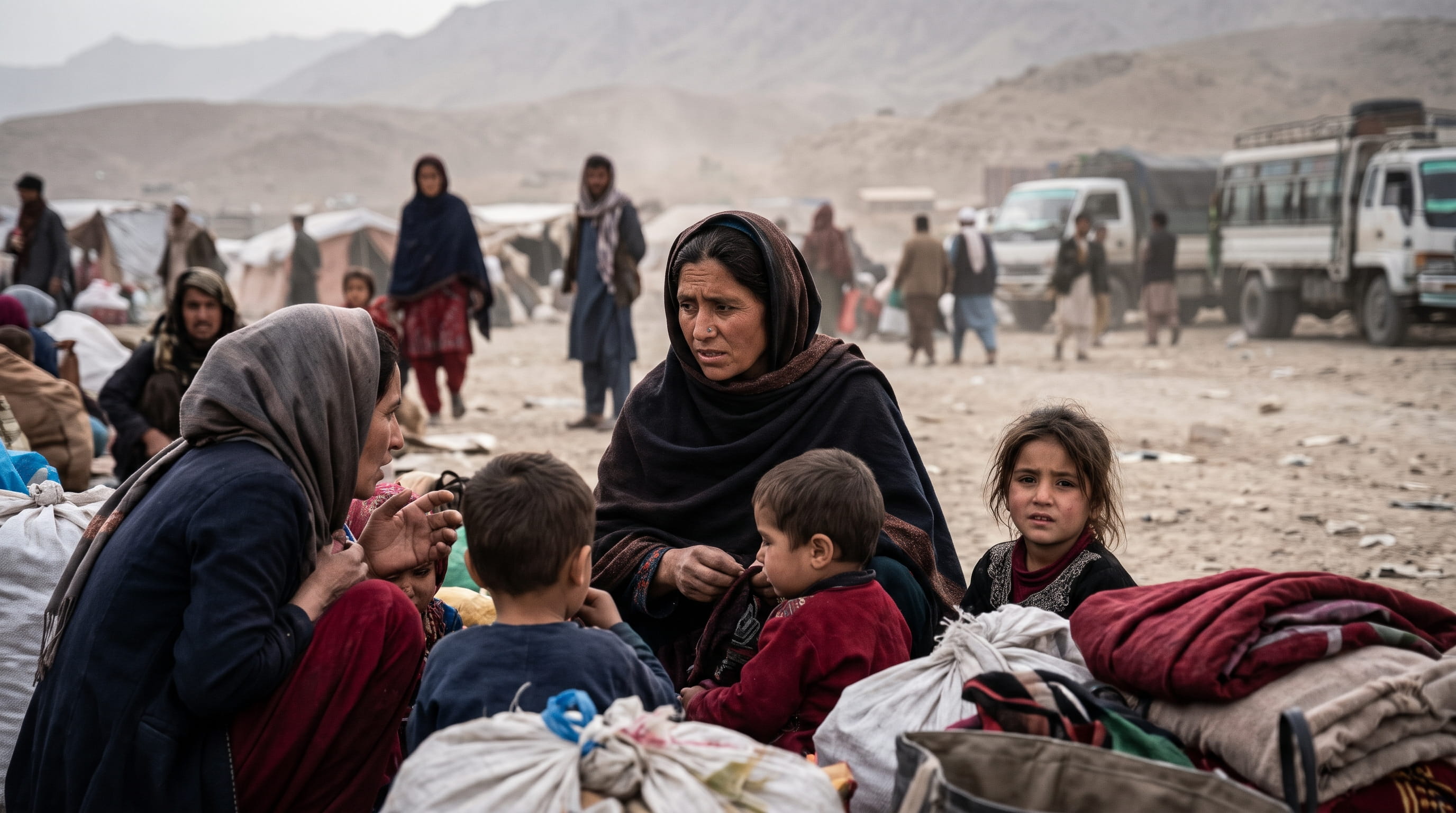
Since 2023, Pakistan’s Illegal Foreigners Repatriation Plan (IFRP) has evolved from targeting undocumented Afghans to Afghan Citizen Card (ACC) holders and Proof of Registration (PoR) card holders more recently. This is one of the largest return movements in South Asia, much of it taking place under coercive conditions, with significant implications for refugee protection and human rights (MSF, 2026). The introduction of the IFRP has affected millions of displaced Afghans who have different legal identities in Pakistan. According to the latest UNHCR–IOM data, a cumulative total of 2,655,205 Afghans were returned from Pakistan between 15 September 2023 and 1 August 2026 (UNHCR–IOM, 2026). Officially justified on grounds of security, administrative control and migration management, the policy has generated significant humanitarian and protection concerns, particularly for gendered, religious, ethnic and sectarian minorities.
Agencies with refugee protection mandate and human rights organisations have documented arrests, arbitrary detention, document expropriation, family separation, and coercive conditions which compel displaced Afghans to return. Police raids, harassment, extortion, and forced removals have intensified pressure on Afghan communities across Pakistan (Human Rights Watch, 2026). International observers have further warned that women, children, female-headed households, asylum seekers, ethnic and religious minorities face serious protection risks upon return, particularly given the deteriorating human rights situation in Afghanistan and the continuing restrictions imposed on women and girls under Taliban rule (Amnesty International, 2025).
Migration control and involuntary return are not gender neutral. Arrests, detention and deportation threats can expose women and girls to intersectional risks. During my fieldwork in Balochistan, Pakistan, Afghan women described how raids, lost livelihoods, barriers to healthcare and extreme weather heightened household tensions and exposed them to gender-based violence at home. Even possessing legal documentation does not eliminate fear. Amnesty International (2025) documented Parwana Rahimi, an Afghan journalist who fled threats linked to her work on women’s rights, and who was threatened with deportation from Pakistan despite holding legal documents. Similarly, Afghan refugee students enrolled in higher education institutions across Pakistan, including a large number of young women, are facing the risk of losing access to university education if returned.
In Afghanistan, women and girls face restrictions on education and socio-spatial mobility. The United Nations High Commissioner for Refugees (UNHCR, n.d.) reports more than 100 decrees restricting women’s rights and the dismantling of legal protections against gender-based violence. The 2026 Response Plan for Afghan Returnees identifies heightened risks of violence, exploitation, forced marriage and exclusion for returning women and girls, while women-headed households and widows face additional barriers to aid, services and social networks (United Nations and NGO Partners in Afghanistan, 2026). Involuntary return may therefore deepen insecurity and increase exposure to GBV among women already subjected to restrictive patriarchal social norms, honour-related stigma and protracted displacement.
For Afghan Women, “Return” Is Not Going Home
For most Afghan women, deportation does not mean a return to safety and belonging; instead, it marks the beginning of another period of displacement, accompanied by insecurities and uncertainty. Life in Pakistan has often been marked by legal uncertainty, poverty, restricted access to education and healthcare, and GBV. Yet even within these difficult circumstances, many women have developed support networks, income-generating opportunities, and a degree of personal autonomy (UN Women Pakistan).
Deportation threatens to dismantle these fragile foundations. Upon return to Afghanistan, women confront a considerably more restrictive environment and intersecting vulnerabilities shaped by Taliban policies. Afghan returnees, particularly women, lose established social networks and livelihood support systems. During my fieldwork, I observed that access to education and humanitarian assistance had been relatively easier for many Afghan families in Pakistan. Quetta, in particular, served as an important destination for Afghan families seeking healthcare for critical and acute medical conditions. Forced returns have disrupted already established patterns, leaving families with fewer options for accessing essential medical services. Although Pakistan officially provides medical visas free of charge, severe processing backlogs and difficulties navigating digital application channels for families with limited literacy have created severe barriers. During my fieldwork, the cost of obtaining medical visas through informal channels was reported to be as high as US$1,300–1,800.
The forced return of Afghan families and the disruption of established livelihood patterns have also heightened women’s exposure to gender-based violence (GBV). During my fieldwork in Balochistan, I encountered instances of forced and early marriages of Afghan girls, as families sought temporary financial relief amid economic hardship. This exploitative practice was evident both during the 2022 flood disaster in Balochistan and throughout the deportation drive that began in 2023. These vulnerabilities are particularly acute for widows, transgender persons, artists, female-headed households, pregnant women and those without family support (UN Women, 2025; UN Women & CARE, 2025). Recognizing the heightened protection needs of these groups, UNHCR has been advocating with the Government of Pakistan for their safety and security.
Understanding Deportation Beyond Administrative Policy
A useful framework for understanding these developments comes from Tervonen and Välimäki’s (2026) article “Covered Tracks? Deportation as a Historical Blind Spot in Twentieth- to Twenty-First-Century Nordic Countries”. They argue that deportation is not merely a response to migration crises but a longstanding instrument of state governance. Historically, deportation has served nation-building projects, welfare-state management, migration control, and the reinforcement of state authority.
The above paper identifies four recurring logics: socioeconomic exclusion, foreign-policy interests, racial and cultural boundary-making, and the state control over mobility. Importantly, it shows how deportation often disappears from public memory because deportees themselves are physically removed from national narratives. This perspective helps explain Pakistan’s current deportation policies. Afghan refugees are frequently portrayed as undocumented/illegal, burdensome, or administratively problematic, while the deeper socio-political consequences of removal receive far less attention. Once deported, the experiences of Afghan women largely disappear from public debate despite the significant risks they continue to face in their country of origin.
Deportation as Structural Gendered Violence
Viewing deportation as an administrative measure masks its gendered consequences. Deportation, a state action and its aftermaths can reproduce and intensify structural inequalities for Afghan women deportees. Drawing on Galtung’s (1969) concept of structural violence, harm is embedded in institutional arrangements that restrict access to resources, opportunities, and life chances. For Afghan women, forced return can mean losing limited existing livelihoods, education, healthcare, assistance, and support networks, while returning to a context where restrictions on socio-spatial mobility, employment, and public participation constrain autonomy. UNHCR’s monitoring (2025) documents gender disparities in income and access to services; UN Women (2025) reports protection concerns, including exploitation and gender-based violence risks among women returnees. UNAMA (2025) has documented human rights violations of returned women and girls. These conditions can deepen dependency and limit women’s ability to make decisions in their lives. Deportation is not directly structural violence; rather, it can re- intensify structural gendered harm when return occurs without legal protection, constitutional or customary obligations.
Legal, Constitutional, and Islamic Obligations
Pakistan’s deportation policies must also be evaluated through the lens of Islamic legal and moral responsibilities. Although Pakistan is not a party to the 1951 Refugee Convention, the principle of non- refoulement—widely recognized as customary international law—prohibits returning individuals to territories where they face persecution or serious harm (UNHCR, 2025a). In the context of Pakistan’s deportation drive, UNHCR has raised concerns about the forced return of Afghan refugees and urged Pakistan to protect individuals with international protection needs from involuntary return (UNHCR, 2025b). Domestically, Articles 4 and 9 of the Constitution of Pakistan protect due process, life, and liberty. These constitutional guarantees are particularly relevant when deportation may expose individuals to foreseeable threats to their safety and dignity.
Islamic legal and ethical principles provide an important framework for examining Pakistan’s responsibilities towards Afghan refugees. As an Islamic Republic, Pakistan’s constitutional framework recognises Islam as the state religion, while the Objectives Resolution, incorporated through Article 2A, emphasises equality, tolerance, and social justice. Within Islamic jurisprudence, Amān refers to the provision of safety, protection, and refuge for those fleeing persecution (regardless of religion, race, gender and ethnicity), while Hijra offers an ethical framework for understanding migration in response to oppression and insecurity. Importantly, Pertek et al. (2026) addresses critical scholarly gap between Amān and the contemporary principle of non-refoulement, arguing that Islamic traditions emphasise protection regardless of nationality, religion, or gender, as well as the safe and voluntary return of refugees. Pertek’s gender-sensitive framework further draws on the maqāṣid al-sharīʿah to emphasize the protection of women’s dignity, life, education, family, and economic well-being (ibidem). These principles offer a compelling Islamic legal and ethical grounds for questioning Pakistan’s’ IFRP drives that may expose Afghan refugees, particularly women, to persecution and serious harm (Pertek et al., 2026; International Committee of the Red Cross, 2021; UNHCR, 2009). UNHCR also notes that Pakistan has neither acceded to the 1951 Refugee Convention and its 1967 Protocol nor enacted comprehensive national refugee legislation. Islamic principles can therefore complement constitutional and international legal arguments for protection, while reinforcing the humanitarian responsibilities associated with the treatment of refugees. (UNHCR Pakistan: Protection).
Beyond Borders
The human cost of deportation becomes clearer through the experiences of Afghan women themselves. UN Women Australia (2025) documented the case of Bibi Hawa, an Afghan woman who had lived in Pakistan for a decade and who was forced to return to Afghanistan just 20 days after undergoing cancer surgery despite her doctor’s advice not to travel. Back in Kandahar with her two young daughters, she feared for their future and worried about their access to education. Bibi Hawa’s story illustrates how deportation can disrupt essential medical care, deepen economic insecurity, expose women to gender- based risks and jeopardise their futures. These are not merely administrative consequences; they are profound disruptions to women’s health, dignity, autonomy and family life.
The debate over Afghan returns, therefore, must extend beyond migration control to the foreseeable human consequences of removal. A humane and rights-based approach requires meaningful assessment of individual protection needs and safeguards against return to serious harm. For women like Bibi Hawa, “return” does not necessarily mean going home; it can mean rebuilding a life amid uncertainty, without adequate healthcare, economic security or confidence about their children’s future. Protecting refugee rights requires recognising these realities before deportation, not only responding to their consequences afterwards.