1 November 2026
According to the Uppsala Conflict Data Program (2025), an estimated 756 million women have been living in a close proximity, defined as 50km radius, of a deadly conflict event. This represents 19% of global female population and constitutes the highest figure recorded since the end of the Cold War in the 1990s. Armed conflicts are accompanied and often preceded by the breakdown of formal and informal community support, social control and legal accountability systems, including those that protect women. As GBV is underreported even during times of peace, understanding, responding to and preventing sexual violence against women and girls in the situation of emergency become even more challenging, especially when humanitarian actors may not be able to access active conflict zones. Furthermore, sexual violence is often used as a weapon of war and patriarchal cultural values may contribute to a sense of impunity among perpetrators. Consequently, there is insufficient robust evidence available on what interventions work to strengthen women’s protection in conflict-affected and under resourced settings.
To understand conflict-related GBV and to design appropriate interventions, several questions need to be taken into account (Nordas 2013):
- When the danger of sexual violence is most acute;
- In what situations it happens;
- Which groups of women are most vulnerable for targeting at any given time;
- Who the perpetrators are;
- What types of sexual violence they perpetrate;
- What this can tell us about why they do it.
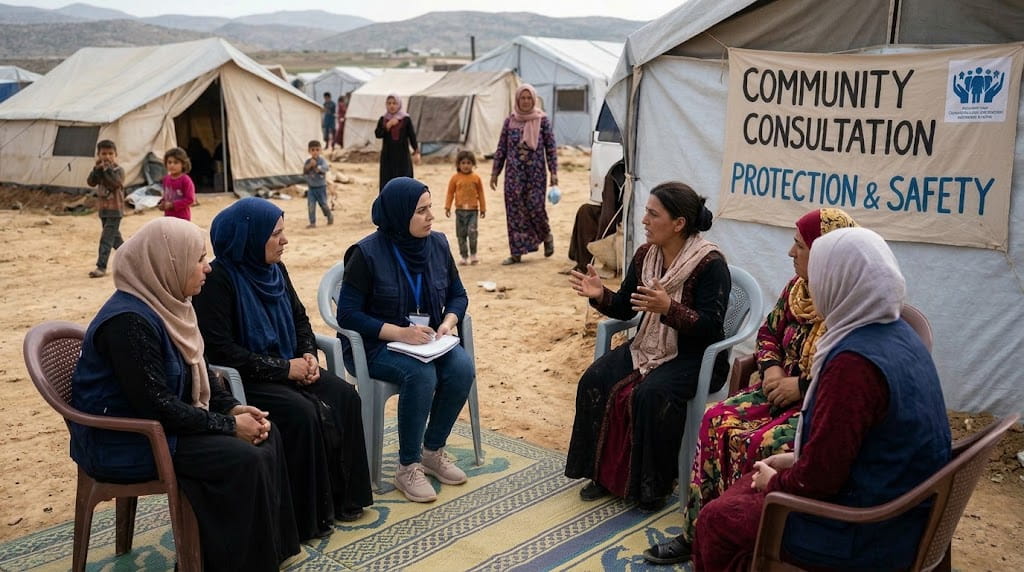
Community consultations are key here and programming must be rooted in a local context (Women’s Refugee Commission, 2016) based on specific protection risks (e.g. kidnapping, human trafficking for sexual exploitation, forced recruitment into armed groups etc). In terms of GBV prevention, there are debates focused on what type of rights, economic, socio-cultural or political have the greatest potential to mitigate attacks on women and girls. Recent study by Barnes et al (2025) argue that we should first and foremost invest in women’s economic rights which can provide them with the ability to flee dangerous war zones, access vital information needed to navigate the risks, work in less vulnerable environments, and live in more safe housing. Their hypothesis based on quantitative desk-based research is that in countries with stronger women’s economic rights, the prevalence of sexual violence during periods of civil conflict will be lower. This claim needs more probing as women’s rights usually are a combination of economic, socio-cultural and political dimensions; it is hard to think of a country where women have economic rights without political rights, for example. These are perhaps more academic discussions, but they do suggest a direction of programming when designing preparedness interventions in the areas prone to conflict. Relevant data ought to be collected before peak of crisis when it becomes very risky to carry out any assessments.
There is nevertheless a general consensus among international GBV service providers and advocates around core programme design and service delivery principles such as creating safe spaces for women and girls, even if those are temporary and mobile, engaging them in programme design and implementation as early as feasible, and maintaining clients’ confidentiality throughout the intervention (Lilleston et al, 2018). The Inter-Agency Standing Committee (IASC) Guidelines for Gender-Based Violence Interventions in Humanitarian Settings which were first published in 2005 were revised in 2015 through a consultative process involving many stakeholders, including UN agencies, NGOs and independent consultants. The updated document contains more examples of ‘promising practices’ than the 2005 edition, and those can be classified into three broader categories:
1. Reducing exposure to risk through proximity of services (e.g. lockable WASH facilities nearby shelters), GBV mitigating spaces (safe waiting areas, gender-segregated sleeping areas) and innovative solutions reducing risk of exposure to GBV
- IDPs camps in Darfur: GBV working group organised training for women to construct and use fuel-efficient stoves. This reduced the amount of wood needed for cooking therefore reducing the time needed for collecting firewood and decreasing exposure to attacks (IASC, 2005)
- North Darfur: in 2009, WFP launched the Safe Access to Firewood and alternative Energy (SAFE) programme which included 33 centres where women make fuel-efficient stoves and fuel briquettes. The SAFE programme has also created safe social spaces where women can be trained on income generation, literacy, nutrition, improved hygiene and community reforestation (IASC, 2015)
- Refugee camps in Kasulu, Tanzania: refugee women (mainly Congolese and Burundian) were transported by truck to collect firewood, escorted by NGO staff and officials of Tanzania’s District Natural Resources Department (IASC, 2005)
- Bhutanese refugee camps, Nepal: UNHCR provided kerosene distributions to households removing risks associated with collecting firewood (IASC, 2005).
2. Community-based protection mechanisms and female-led aid distribution
Darfur: Unitarian Universalist Service Committee designed a programme which was implemented by UNIFEM. As a result of community sensitisation conducted during the programme, camp leaders formed gender committees and firewood committees so that women had access to decision makers. Through the firewood committees, women could provide regular feedback on the United Nations Police patrols. As a result, the head of the Department of Peacekeeping Operations (DPKO) in Darfur agreed to train all police on gender sensitivity. The Sudanese police also requested training and deployed more female police in the camps, whist men in the camps asked for training on women’s rights and protection. Several camps also formed community policing groups, approximately half of whose members were women (IASC, 2015).
3. Maintaining access to basic support for survivors under conditions of insecurity in spaces deemed ‘safe’ in a given context, or through deployment of mobile teams
A safe space is a formal or informal place where women and girls feel physically and emotionally safe. In the context of armed conflict, mass displacement, destroyed infrastructure, non-functioning police and courts, and no specialist GBV services, this could be a tent or a mobile unit composed of female outreach workers (including trained volunteers), where women can receive information, disclose accounts of violence confidentially, and access basic first aid. Where there are no dedicated services where women could be referred to, such space serves as a community focal point and enables initial survivor identification. Mobile teams who move door-to-door can identify women at immediate risk and reduce their social isolation through active listening as well as alert humanitarian agencies about emerging threats which can later be fed into identification of priority needs and overall field documentation. When financial institutions closed and internet connection is intermittent, those teams could also distribute small cash assistance using informal money transfer systems such as hawala. This depends on the severity of security context and must consider the safety of people moving around with cash. Similarly, facilitating women’s access to relatively safer locations with even minimal service hubs may be more effective but not always possible. This will be determined by geography, including conflict hotspots and buffer zones, infrastructure (accessibility of roads, checkpoints, permits, warehouses), political actors (armed groups involved in a conflict), presence of humanitarian actors, socio-cultural factors (e.g. requirement of male guardianship), patterns of conflict’s intensity and type of warfare (e.g. use of modern technology such as drones).
- Syria: UNFPA worked with partners to establish safe spaces in reproductive health clinics. This approach allowed for a more confidential and holistic service provision that addressed – to a certain extent, depending on whether such facilities were also under attack – the security concerns in Syria (UNFPA, 2015).
- Lebanon: UNFPA worked through Listening and Counselling Centres that were part of the local pre-crisis Lebanese system. These centres also offered activities for children to facilitate mothers’ participation in the sessions (UNFPA, 2015).
- Iraq: UNFPA has set up safe spaces within existing cultural centres in urban settings as they were trusted by the communities. Specific hours and days were allocated to women-only activities. In the camps, designated safe spaces were established with a focus on outreach (UNFPA, 2015).
- Somalia: nutrition centres were considered the only safe and secure place for women. Consequently, UNICEF caseworkers were sent to nutrition centres during opening hours to create a safe and confidential space for women and girls to share their experiences. Those who disclosed information about sexual assault were recommended for further services, such as emotional support and clinical care for survivors of rape. The caseworkers also trained nutrition centre staff on these referral systems (IASC, 2015).
- Democratic Republic of Congo: World Food Programme (WFP) distributed food to survivors of sexual violence admitted to the hospital. Food assistance supported women to stay in hospital for the time needed to recover, where they also received psychological counselling, advice on socio-economic matters and legal issues as well as learned new skills such as making handicrafts (IASC 2015).
Evaluations of women and girls’ safe spaces are most common but there is less information about mobile teams (Lileston et al, 2018) in the settings were built environment, including hospitals and schools, is deliberately targeted and destroyed, such as in Gaza. However, strong community structures and volunteerism do exist in Gaza (e.g. community kitchens) and Sudan (e.g. Sudan Humanitarian Fund which relies entirely on public donations). The aid sector should learn from those initiatives and include local actors in their clusters, including protection; it is essential to build the resilience of communities in participatory ways as part of the localisation agenda.
Selected bibliography:
Barnes, T., Johnson, J. C., McAtee, A., Vyas, G. (2025) Women’s economic rights and sexual violence in civil conflict, Journal of Peace Research, Volume 62, Issue 6: 1646–1662, Available at: Women’s economic rights and sexual violence in civil conflict | Journal of Peace Research | Oxford Academic
Global Women’s Institute and International Rescue Committee (2016) Evidence brief: What works to prevent and respond to violence against women and girls in conflict and humanitarian settings?. Washington DC: George Washington University and London: IRC, Available at: p868ircsynthesisbriefreportlr.pdf
Holmes, R., and Bhuvanendra, D. (2014) ‘Preventing and responding to gender-based violence in humanitarian crises’, Humanitarian Practice Network Paper, 77: 1-27, Available at: Preventing and responding to gender-based violence in humanitarian crises | Humanitarian Practice Network
Inter-Agency Standing Committee (2005) Guidelines for Gender-based Violence Interventions in Humanitarian Emergencies: Focusing on Prevention and Response to Sexual Violence, Available at: Guidelines for Gender-based Violence Interventions in Humanitarian Settings.pdf
Inter-Agency Standing Committee (2015) Guidelines for Integrating Gender-Based Violence Interventions in Humanitarian Action: Reducing risk, promoting resilience and aiding recovery, Available at: IASC Guidelines for Integrating Gender-Based Violence Interventions in Humanitarian Action, 2015.pdf
Lilleston, P., Winograd, L., Spogmay, A., Salamé, D., Al Alam, D., Stoebenau, K., Michelis, I., Palekar Joergensen, S. (2018) ‘Evaluation of a mobile approach to gender-based violence service delivery among Syrian refugees in Lebanon’, Health Policy and Planning, Volume 33, Issue 7: 767–776, Available at: Evaluation of a mobile approach to gender-based violence service delivery among Syrian refugees in Lebanon – PubMed
Nordas, R. (2013) ‘Preventing conflict-related sexual violence’, PRIO Policy Brief, 2. Oslo: PRIO, Available at: Preventing Conflict-related Sexual Violence – Peace Research Institute Oslo (PRIO)
Nordas, R. (2012) ‘Sexual violence on the decline? Recent debates and evidence suggest ‘unlikely’, CSCW Policy brief, 3, Oslo: CWSW, Available at: Sexual Violence on the Decline? Recent debates and evidence suggest ‘unlikely’ – Peace Research Institute Oslo (PRIO)
UNFPA (2015) Women and girls safe spaces: A guidance note based on lessons learned from the Syrian crisis, Available at: Women & Girls Safe Spaces: A guidance note based on lessons learned from the Syrian crisis | United Nations Population Fund
Uppsala Conflict Data Program’s Georeferenced Event Data set Global, version 26.1, Available at: UCDP – Uppsala Conflict Data Program
Women’s Refugee Commission (2016) I’m here: Steps and tools to reach adolescent girls in crisis, New York: Women’s Refugee Commission, Available at: Im-Here_2016-Update.pdf
Additional materials to review:
Publications | Sexual Violence in Armed Conflict
Women’s Rights Fund: occupied Palestinian territory (oPt) | Oxfam GB